
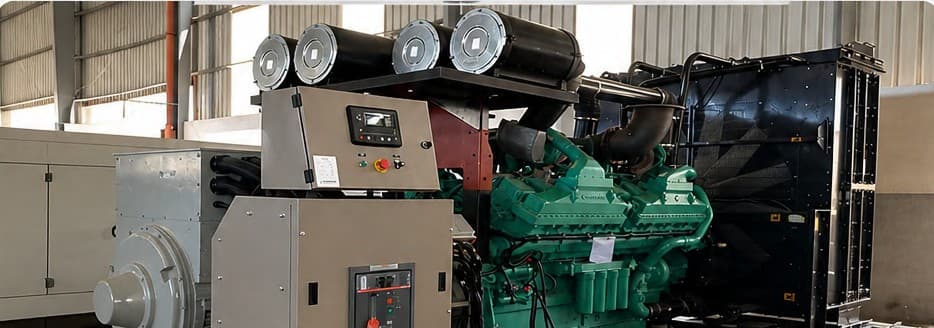
Three numbers, one engine
Every generator datasheet carries a standby rating and a prime rating, and larger sets add a continuous rating. They are defined by ISO 8528-1. Standby (ESP) is the maximum power the set can deliver for the duration of a utility outage, with no overload capability and a limit on hours per year. Prime (PRP) is the maximum power available for an unlimited number of hours at variable load, with a 10 % overload allowed for short periods. Continuous (COP) is the power the set can deliver at constant load for unlimited hours — typically a further 10–15 % below prime.
As a rule of thumb, prime is about 10 % below standby: a 550 kVA standby set is roughly a 500 kVA prime set. The brochure prints the largest number; the duty decides which one is yours.
Match the rating to the duty
Buy on the standby rating when the set only covers utility outages: hospitals, hotels, towers, data centres and factories connected to the Saudi grid. The set runs a few hours a month plus a weekly test, so the standby limit is never an issue, and you get the most capacity for the money.
Buy on the prime rating when the generator is the main power source: construction camps, NEOM and Red Sea sites, farms, quarries and telecom sites off the grid. These sets run every day at varying load, and a set bought on its standby number will be overloaded and worn out years early. Buy on the continuous rating only for constant base-load duty — a pump station, a process plant, a data centre running on generators by design.
The 70–90 % loading rule
Whatever the rating, diesel engines are healthiest between roughly 50 and 90 % of it. Below 30 % for long periods they wet-stack: unburned fuel fouls the exhaust, injectors and turbo. Above the rating they overheat and trip. A good sizing lands the typical load at 70–80 % and keeps the peak under 90 %, which is why our calculator adds a 10 % margin on top of the derated requirement.
For a prime-duty site with a wide gap between night and day loads, two smaller sets in parallel beat one large set: one carries the night load efficiently, both share the day peak, and one can be serviced without a blackout.
What to write on the purchase order
State the rating you are buying: “500 kVA prime / 550 kVA standby at 60 Hz, 0.8 PF, 50 °C ambient” leaves no room for a supplier to quote the standby number as if it were prime. Ask for the derated figures at your site temperature and altitude — a set rated at 25 °C in the catalogue does not deliver the same in a Jeddah July.
On every BRO Global offer the standby and prime ratings appear side by side at your frequency, with the engine model and the OEM datasheet attached, so the consultant can verify both.