
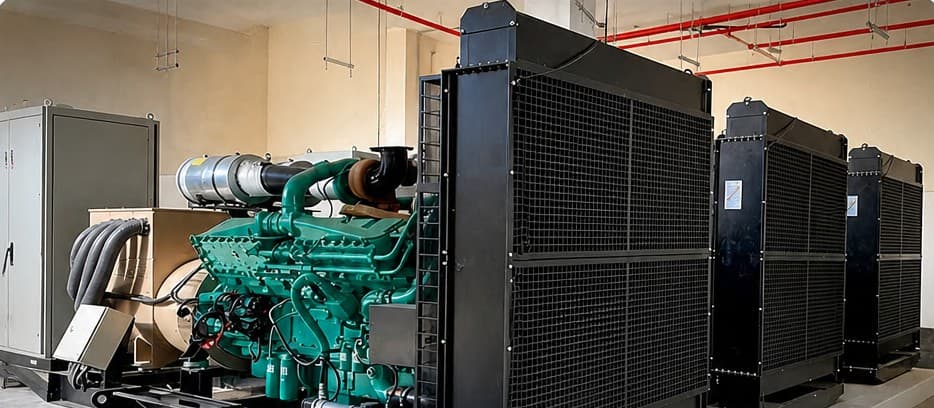
Diesel generators, explained for Saudi projects.
Guides written by the team that sizes, supplies and commissions the sets — grouped by where you are in the decision. No sign-up, no jargon left unexplained.
Knowledge Center
Choosing the right set
Size, rating, frequency and application — get the specification right before you ask for prices.
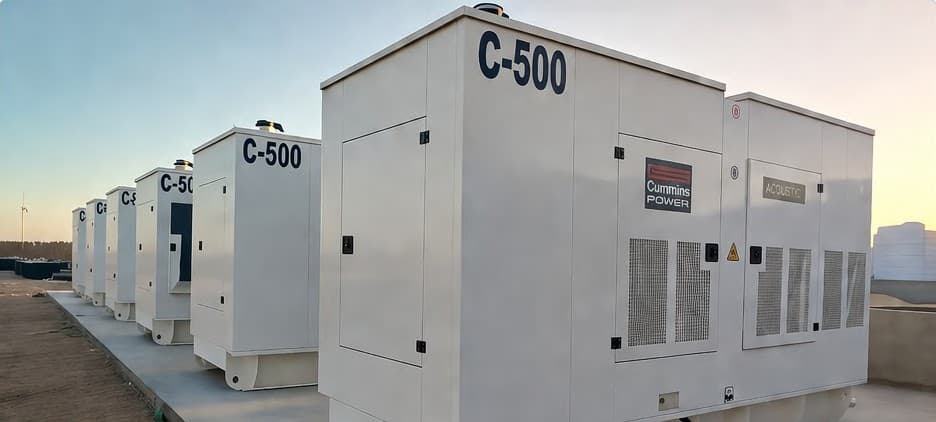
How to size a diesel generator for your project — a practical kVA guide
Undersize a generator and it trips on the first compressor start. Oversize it and you pay for capacity that wet-stacks at low load. Here is the practical middle path.
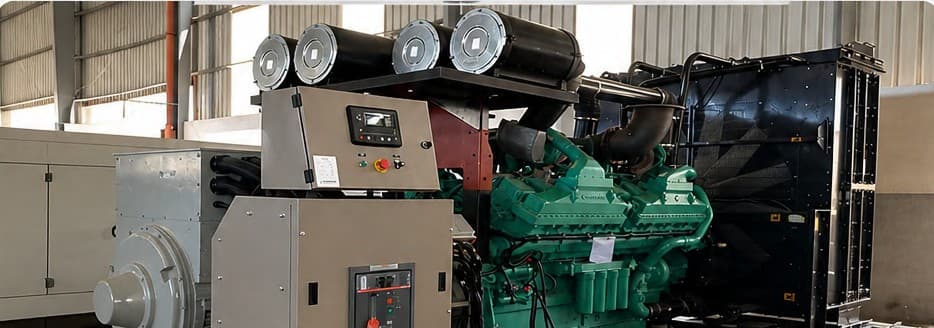
Standby vs prime vs continuous: which generator rating should you buy?
The same engine is sold with two or three different kVA numbers. Buy on the wrong one and the set either costs too much or dies early. Here is how to choose.
50 Hz or 60 Hz? Choosing the right generator frequency for Saudi Arabia and the Gulf
The single most expensive mistake we see on imported generators is frequency. The Kingdom is the odd one out in the Gulf, and the difference changes the engine speed, the rating and the price.
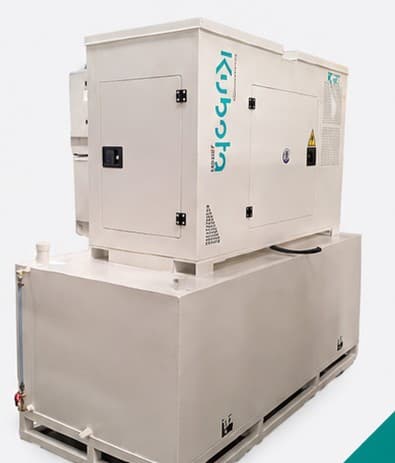
Which generator for a villa in Saudi Arabia? Sizing, noise, fuel and what it costs
A villa generator is sized by the air-conditioning, not the lights. Here is the practical guide we give homeowners and contractors in Jeddah and Riyadh.
Knowledge Center
Buying and comparing
What things cost, which brand fits which job, and what a proper offer must include.
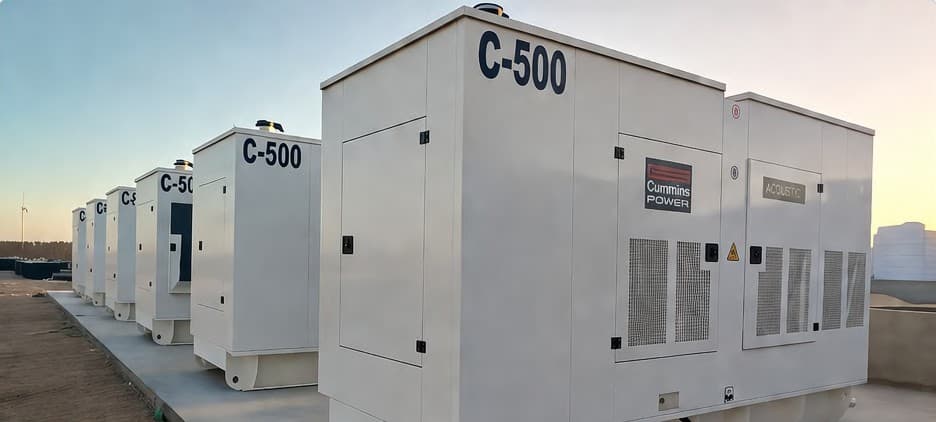
Diesel generator prices in Saudi Arabia (2026): what a 30 to 2,500 kVA set really costs
Buyers ask us the same question every week: how much does a generator cost? Here are honest 2026 ranges by size, what moves the price up or down, and what a proper offer must include.
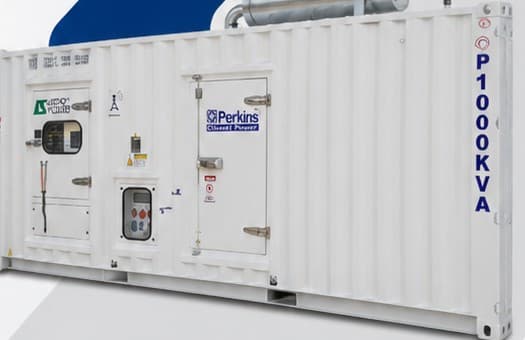
Perkins vs Cummins generators in Saudi Arabia: which engine should your project run on?
Both brands are excellent; they win different jobs. Here is the comparison we give buyers who ask us which to specify.
Knowledge Center
Owning and running
Maintenance, testing and the habits that keep a set ready on the day of the outage.
Tools
Do the numbers yourself
Sizing calculator
Pick appliances or enter kW; get a recommended kVA and the nearest models with Saudi derating applied.
OpenSelection chart
130+ ratings from multiple engine brands at 50 and 60 Hz, each with a one-click quote request.
OpenBrowse by kVA
Models, fuel use and what a given size powers, from 20 to 2,500 kVA.
OpenFAQ index
Questions buyers ask us, answered — General
Collected from every generator page on the site — general questions first, then city-specific ones.
Should I order 50 Hz or 60 Hz?
What is the difference between standby and prime rating?
Do Saudi temperatures reduce generator output?
Are the generators new and do they come with warranty?
How fast can you deliver?
Can you supply ATS, synchronising panels and fuel tanks?
Do you provide documents for consultant approval?
Questions buyers ask us, answered — By city and region
Which generator brands do you supply?
Do you supply silent or containerized generators?
Do you deliver generators across Saudi Arabia?
How fast can you deliver a generator in Jeddah?
Do you supply generators to construction sites in Riyadh?
Can you specify a generator for continuous industrial load?
Do you have quiet generators suitable for residential and hotel sites?
Can you deliver to Makkah quickly during Hajj and Ramadan?
Which generator is right for a hotel or pilgrim housing tower?
Do you supply the automatic transfer switch (ATS) as well?
How fast can a generator reach Madinah?
Do you install and commission in Madinah?
Is the warranty valid in Madinah?
Do you provide the technical submittal package required on industrial sites?
Can you supply synchronised multi-set plants for large loads?
Do you deliver to the Royal Commission and gated industrial areas?
How long does delivery from Jeddah to Yanbu take?
Can you supply sets for the Royal Commission industrial area?
Do you offer prime-rated sets for camps that run on generator power daily?
Which rating should a NEOM camp generator be sized on?
Do you provide remote monitoring and spare parts for far sites?
Can you deliver containerized plants to the Red Sea and NEOM sites?
Does altitude really reduce generator output in Abha?
Which brands do you recommend for Asir hospitals and universities?
Do you deliver and commission in the mountains?
Do you supply 50 Hz generators for the UAE, Qatar, Bahrain, Kuwait and Oman?
How do you ship generators to the GCC and who handles customs?
Can you quote DDP to a GCC site?
Glossary
Generator terms in plain language
- kVA (kilovolt-ampere)
- The apparent power a generator can deliver. Generators are rated in kVA; multiply by the power factor to get usable kW. 500 kVA × 0.8 = 400 kW.
- kW (kilowatt)
- Real power actually consumed by the load. Your equipment nameplates and bills are in kW; convert to kVA (÷ 0.8) to size the generator.
- Power factor (PF)
- The ratio of kW to kVA, 0.8 for typical mixed loads. Motors pull it down; lighting and heaters push it toward 1.0.
- Standby rating (ESP)
- Maximum output for emergency use during a utility outage — limited hours per year, no overload. The largest number on the datasheet.
- Prime rating (PRP)
- Output available for unlimited hours at variable load with a 10 % overload allowance. About 10 % below standby; size on it when the set is the main power source.
- Continuous rating (COP)
- Output at constant base load for unlimited hours — for pump stations, process plants and sites that run on generators by design.
- 50 Hz / 60 Hz
- Grid frequency. Saudi Arabia is 60 Hz (1800 rpm sets); the UAE, Qatar, Bahrain, Kuwait and Oman are 50 Hz (1500 rpm). A set must match the grid it connects to.
- Derating
- Reduction of rated output for site conditions: roughly 1 % per °C above 40 °C and 3 % per 300 m above 1,000 m altitude.
- Load schedule
- The list of every connected load with running power and starting behaviour — the starting point of any honest sizing.
- Motor starting (DOL)
- A direct-on-line motor draws about six times its running current for a few seconds; the set must absorb that surge without a damaging voltage dip.
- Open type (skid)
- Engine, alternator and controller on a base frame without an enclosure — for ventilated plant rooms.
- Silent canopy
- A weather-proof, sound-attenuated enclosure, typically 70–75 dB(A) at 7 m; super-silent versions go below 65 dB(A).
- Containerized set
- A 20 or 40 ft ISO container with acoustic lining, fuel system and cable trays — a complete plant that arrives on a lowbed.
- ATS (automatic transfer switch)
- Detects a utility failure, starts the generator and transfers the load, then transfers back when the grid returns — no one has to go outside.
- Synchronising / paralleling
- Running two or more sets together on one busbar with load sharing, for large loads or redundancy. Needs synchronising controllers and switchgear.
- DSE (Deep Sea Electronics)
- The most common generator controller brand; the DSE 7320 and 8610 models handle auto-start, protection, monitoring and synchronising.
- Alternator
- The part that turns the engine's rotation into electricity. Leroy Somer and Stamford are the two reference brands on quality sets.
- Base tank / day tank
- Fuel storage built into the set's base frame (typically 8 hours at 75 % load) or a separate daily tank fed from a bulk tank.
- Fuel consumption
- Roughly 0.21 litres of diesel per kWh delivered at 75 % load; a 500 kVA set burns about 63 L/h at that load.
- Wet-stacking
- Fouling of the exhaust and injectors when a diesel runs for long periods below about 30 % load — the hidden cost of oversizing.
- Load bank test
- Running the set against an artificial load for one to two hours to prove its rating and burn off carbon — done at the factory and yearly on site.
- OEM datasheet
- The manufacturer's specification sheet for the exact engine and set — ratings at 50 and 60 Hz, fuel curve, dimensions, weight. Part of every BRO Global offer.
- Technical submittal
- The document package (datasheets, drawings, certificates) a consultant reviews and approves before a set is manufactured or accepted.
- Tropical radiator
- A larger cooling package specified for 50 °C ambient so the set delivers its rating in a Saudi summer.
Still have a question your load schedule can answer?
Send it to power@broglobal.net or WhatsApp us — a sized, priced offer within 24 hours.